
FOOD & AI

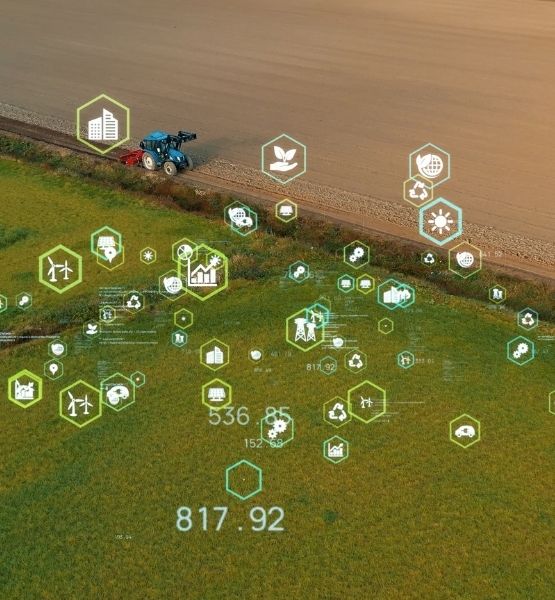
Producing better: from precision agriculture to continuous safety
Thanks to AI, the entire food system is being reinvented in a way that is more agile, rational, and creative. The food chain is transforming at its very source. Thanks to connected sensors, drones, satellite imagery, and predictive models, precision agriculture now allows for anticipating plant needs, better understanding soil evolution, and adapting irrigation or inputs in an ultra-localized manner. This approach simultaneously improves yields and reduces environmental impact, a necessity in a context of climate tension. With global food demand projected to increase by 50% by 2050, the ability to produce more with less is no longer optional, it is existential.
In factories and processing plants, AI provides continuous monitoring of product quality. Computer vision detects real-time variations in texture, color, or shape that may signal a quality defect or health risk. Predictive models analyze production data to anticipate drifts, reduce line downtime, and guarantee consistent standards. Industry players are moving from occasional spot checks to continuous food safety. This shift also has a direct economic impact: fewer recalls, less waste, and stronger consumer trust, all critical competitive advantages in today's market. This human-machine collaboration is not a limitation: it is a strength, and a guarantee of long-term trustworthiness for both regulators and consumers.
Data serving science: the essential foundations of AI
AI does not "guess": it calculates and analyzes the data provided to it. In the food sector, where the slightest approximation can alter nutritional quality or mislead the consumer, data reliability is a central issue. AI models must rely on accurate nutritional analyses, consistent benchmarks, rigorous scientific reading, and a contextualized understanding of physiological mechanisms. Poor data doesn't just produce poor results, in the food industry, it can directly affect public health and brand credibility.
This is where human expertise is indispensable. Companies rely on scientific authority specialists, such as the Evidence Santé agency, to verify data, interpret results, guarantee the validity of nutritional information, and ensure that AI-generated conclusions are scientifically sound. Technology does not replace science: it builds upon it and depends entirely on it. This human-machine collaboration is not a limitation, it is a strength, and a guarantee of long-term trustworthiness for both regulators and consumers.
Hyper-personalization: toward a daily food assistant
Personalized nutrition is reaching a decisive milestone. AI models now integrate thousands of parameters, physical activity, eating habits, budgetary constraints, health goals, allergies, individual tastes, to offer contextualized and relevant recommendations. This ability to assimilate vast volumes of information paves the way for tailor-made nutrition. What was once reserved for elite athletes or clinical patients is now becoming accessible to every consumer, at scale.
A concrete example comes from the United States, where Walmart integrated OpenAI models into its customer experience. With a simple phrase like "I'm making dinner for six," the consumer can obtain a complete shopping list, menu suggestions adapted to their preferences, portion adjustments, allergy alternatives, and even a basket optimized for their budget. AI acts as a daily food assistant, capable of supporting choices without ever replacing the expertise of a nutritionist. This type of seamless, intelligent experience is quickly becoming the new standard, and consumers who experience it once rarely want to go back.
The unexpected alliance: AI and human creativity
Contrary to popular belief, AI does not reduce creativity: it amplifies it. In R&D departments, generative models test in minutes what would take full teams weeks: ingredient combinations, unique aromatic pairings, healthier reformulations, virtual product prototypes, texture variants, or packaging ideas. This acceleration is particularly valuable in a market where consumer trends shift faster than ever and the window to launch a relevant product is increasingly narrow.
However, human intuition remains irreplaceable. Project managers, engineers, marketing leads, and sensory experts are the ones who transform these leads into real innovations. AI proposes directions, but it is human creativity that gives meaning, understands culinary culture, decodes gustatory emotions, and imagines new uses. The most successful food companies of tomorrow will be those that master the art of blending algorithmic intelligence with deeply human insight.
Tomorrow’s challenges: governance, ethics, and sustainability
As food industry players lean on AI, governance issues become essential. Transparency of data sources, scientific validation, personal data protection, model auditability, and bias management are now part of companies' strategic responsibilities.
In a context marked by climate change and resource pressure, AI helps imagine leaner, more circular, and more efficient models. But this transition requires new hybrid skills: professionals capable of simultaneously understanding food science, data, ethical stakes, and AI applications.
An augmented, yet profoundly human ecosytem
SIAL Paris 2026 will highlight a major conviction: the future of food rests on the alliance of three forces:
- Scientific rigor: essential for validating and contextualizing data.
- Technological power: capable of analyzing, predicting, and personalizing.
- Human creativity: which imagines the products, stories, and food experiences of tomorrow.
Everything you need to know about IA and food
-
How is AI transforming food production?AI-powered tools like drones, connected sensors, and predictive models enable precision agriculture, optimizing irrigation, anticipating crop needs, and reducing environmental impact while improving yields.
-
Can AI guarantee food safety?Yes. Computer vision and predictive models continuously monitor product quality on production lines, detecting defects in real time and replacing traditional spot-checks with a fully continuous safety process.
-
Is AI reliable enough to handle nutritional data?AI is only as good as the data it's fed. That's why human scientific expertise remains essential, specialists validate nutritional information and ensure that AI-generated conclusions are scientifically sound.
-
How does AI personalize our diet?AI analyzes thousands of parameters, health goals, allergies, budget, food preferences, to deliver tailored recommendations. Walmart's partnership with OpenAI is a great example: shoppers get full meal plans from a single prompt.
-
Does AI replace human creativity in food innovation?Not at all. AI accelerates R&D by testing ingredient combinations and product concepts on a scale, but human intuition, culinary culture, and sensory expertise are what turn those ideas into real, meaningful innovations.
Our partner