
MINI-CROISSANTS: A TIME-HONOURED CLASSIC REINVENTED

The croissant occupies a singular place in French culinary identity, yet its story begins beyond France. Its journey from a crescent-shaped Viennese pastry to a global staple has given rise to numerous variations, including the increasingly popular mini-croissant format.
From kipferl to croissant: a layered history
The origins of the croissant are often traced back to the Austrian kipferl, a crescent-shaped bread documented as early as the 13th century. Its introduction to France is widely associated with the 19th century, when Viennese bakeries began to appear in Paris. Over time, French bakers transformed the original recipe by incorporating laminated dough techniques using butter, giving rise to the flaky, layered texture now synonymous with the croissant.
By the early 20th century, the croissant had become embedded in French breakfast culture. Industrialisation and bakery standardisation further contributed to its spread, turning it into a staple not only in France but across Europe and beyond. According to various bakery industry analyses, viennoiserie products, including croissants, continue to represent a significant share of baked goods consumption in Europe, with steady growth driven by convenience formats and on-the-go eating habits.

The emergence of mini-croissants reflects a broader shift in portioning and consumption. Smaller formats respond to changing lifestyles, where flexibility, sharing and snacking play an increasing role. This aligns with wider trends observed across the food industry trade show landscape, where individual portions and hybrid formats are gaining prominence.
The rise of the mini format in contemporary snacking
Mini-croissants, particularly savoury versions, have become closely associated with apéritif culture in France. Their appeal lies in their versatility. They can be served warm or cold, adapted with various fillings and easily shared among guests. This format responds to a growing demand for informal, convivial eating occasions.
Recent data highlights the strength of the snacking and convenience segment. In Europe, savoury bakery products have seen renewed interest, with growth supported by retail innovation and foodservice expansion. Ready-to-eat and easy-to-prepare items continue to perform strongly, reflecting evolving consumer expectations around simplicity and indulgence.
Technique, simplicity and sensory appeal
What defines a successful mini-croissant is the balance between texture and flavour. The laminated dough must achieve a crisp exterior while retaining a soft, airy interior. The filling should complement rather than overwhelm the pastry.
A light application of mustard introduces subtle sharpness, enhancing the savoury profile without dominating it. The use of Gruyère, Emmental or Comté ensures meltability and depth, while the option to incorporate herbed cream cheese adds richness and softness.
This combination reflects a broader culinary logic. Familiar ingredients are reassembled in ways that elevate everyday formats. The result is both recognisable and slightly reinterpreted, a dynamic that resonates strongly within contemporary gastronomy.
The preparation itself remains accessible, reinforcing the idea that such recipes can be replicated at home or scaled within professional contexts. This adaptability is particularly relevant for operators across the food industry sectors, from catering to retail, where reproducibility and consistency are key.
A living recipe within SIAL Off
SIAL Off highlights places across Paris where visitors can experience the city’s food scene beyond the exhibition. From restaurants to food shops, it offers a different way to explore local gastronomy alongside the event.
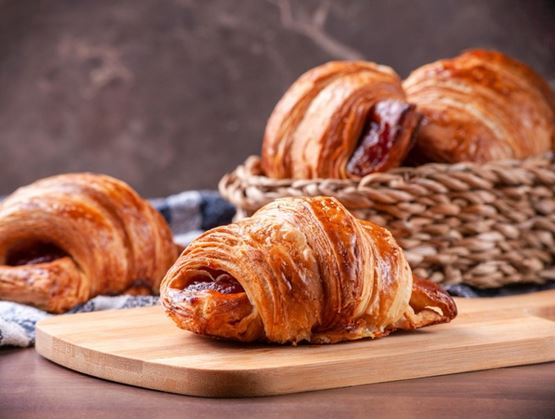
As part of SIAL Off, members of the SIAL Paris team are sharing some of their favourite recipes, bringing a personal touch (see Julien’s French Onion Soup or Margeaux’s crepes). Laurine’s mini croissants are a good example, showing how classic formats can be adapted in a simple and creative way.
The recipe also reflects broader trends in the industry, with a focus on convenience and quality. Using good ingredients, like butter-rich pastry or well-chosen cheese, makes all the difference without adding complexity.
Laurine mini-croissants offer a practical example of how tradition continues to evolve through individual creativity.
Laurine s mini-croissants with ham and cheese

Ingredients for 16 to 20 pieces
1 sheet all-butter puff pastry
3 thin slices of cooked ham or turkey
100 g grated Gruyère, Emmental or Comté
1 teaspoon mild mustard, optional but recommended
1 egg yolk
Black pepper
Sesame or poppy seeds, optional
Method
Step 1
Preheat the oven to 180°C.
Step 2
Unroll the puff pastry and cut it into 8 or 16 triangles, depending on the desired size.
Step 3
Lightly spread a small amount of mustard on the base and tip of each triangle.
Step 4
Add finely cut ham and a portion of grated cheese. Season lightly with pepper. Additional fillings such as herbed cream cheese may be included for a softer texture.
Step 5
Roll each triangle from the wide end towards the tip to form a croissant shape.
Step 6
Place on a baking tray lined with parchment paper. Brush with egg yolk and sprinkle with seeds if desired.
Step 7
Bake for 15 to 18 minutes until golden brown.
Step 8
Serve warm or at room temperature.
Crisp on the outside and soft within, these mini-croissants capture the essence of convivial dining while remaining firmly rooted in the tradition of French viennoiserie.
Where to find them in Paris
La Grande Épicerie de Paris – Rive Gauche offers refined versions made with high-quality butter pastry, suitable for a more elevated apéritif.
Maison Kayser bakeries provide a more artisanal interpretation, rooted in traditional baking techniques.
Images credits: Vladimir Sladek, Marceloverve, Pixabay from Pexels, SIAL Paris