
A TRAVELING PASTRY: THE JOURNEY OF RUGELACH

A pastry shaped by centuries: rugelach and the evolution of festive baking
In a year where the SIAL ecosystem continues to explore the relationship between memory, innovation and gastronomy, rugelach offers an ideal lens through which to understand how traditional pastries travel, transform and transcend borders. Often recognised by its crescent shape and rich fillings, rugelach carries a story that spans Central Europe, diasporic journeys and contemporary reinterpretations. This sweet treat represents the endurance of culinary identity at a time when the food sector is undergoing profound shifts.
Rugelach originated in the Jewish communities of Poland, Hungary and Galicia, where bakers shaped rolled pastries filled with nuts, preserves or spices long before chocolate became common in European kitchens. As historian Gil Marks notes in his Encyclopaedia of Jewish Food, early rugelach were made with yeasted dough and resembled small rolled kifli or kipferl, pastries closely related to the ancestors of the French croissant. When Jewish families migrated to Western Europe and later to the United States, the recipe evolved, particularly with the introduction of cream cheese dough in the twentieth century. This small change reshaped rugelach into the tender, crumbly pastry many associate with modern Jewish bakeries today.
At SIAL Paris, where global food culture and contemporary innovation intersect, rugelach embodies the show’s broader narrative: how rooted traditions continue to evolve in response to new techniques, ingredients and consumer expectations. It is precisely this dynamic between heritage and transformation that makes pastries like rugelach resonate with today’s consumers.
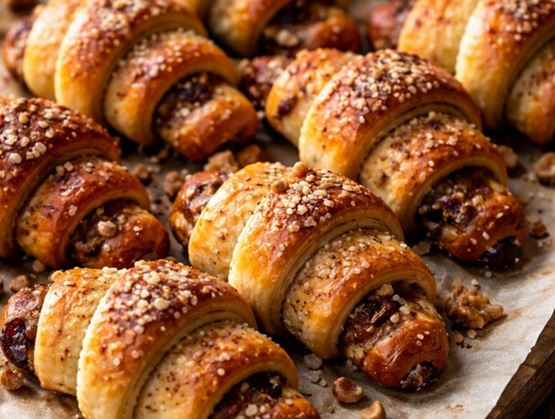
The cultural journey of rugelach: from Central Europe to contemporary gastronomy
The appeal of rugelach lies not only in its flavour but in its adaptability. Historically, bakers filled the dough with whatever preserved fruits or nuts they had on hand during harsh winters.
Cinnamon, cocoa and chocolate, now common ingredients, became more widely available in the nineteenth century thanks to the expansion of European trade routes and the rise of patisserie culture in cities like Vienna, Budapest and Paris. This evolution mirrors the broader development of European pastry, where ingredients once considered luxuries gradually became everyday staples.
By the twentieth century, rugelach had become a familiar feature of Jewish delis in New York, where cream cheese dough, made possible by industrial dairy production, gave it a distinctly American twist. As historian Claudia Roden explains, many Jewish pastries retained their symbolic meaning even as their ingredients reflected the local markets and technologies of their new homes. Rugelach is no exception: its shape and structure remain recognisable, but its fillings and textures have continuously adapted to each era.
Today, this culinary adaptability echoes the tone of modern innovation showcased at SIAL Paris. Whether through plant-based formulations, reduced-sugar approaches, or reinterpretations by contemporary chefs, heritage pastries continue to evolve alongside shifting habits and emerging technologies. In this sense, the rugelach recipe presented for SIAL OFF becomes part of a wider dialogue about how pastries can remain faithful to history while meeting new tastes and trends.
The SIAL OFF chocolate-cinnamon rugelach: a recipe rooted in tradition and open to reinvention
The SIAL OFF version of rugelach honours the pastry’s Eastern European lineage while adding a generous chocolate-cinnamon filling that reflects modern preferences for richer, more indulgent flavours. The dough is made using cold Philadelphia cream cheese or mascarpone, a method popularised in American-Jewish baking that produces the characteristically soft, delicate crumb.
The preparation follows a series of precise steps that reveal the craftsmanship behind this seemingly simple pastry. Cold butter and cream cheese are combined with flour, a pinch of salt and a single egg yolk to create a smooth, pliable dough. After resting, each disc is rolled out and brushed with softened butter before receiving a mixture of dark chocolate, cocoa, sugar and cinnamon. Cut into twelve triangles and rolled from tip to base, the pastries are chilled before baking to preserve their shape. Once golden, they are brushed with a light syrup that enhances shine and flavour, a technique still used in Eastern European kitchens.
For readers eager to taste additional variations, the Parisian bakery Babka Zana offers some of the most indulgent rugelach available in the city, including chocolate-cinnamon versions similar to the one featured here. Its popularity illustrates how traditional pastries continue to thrive in contemporary food settings, from artisanal bakeries to cafés inspired by global Jewish cuisine.
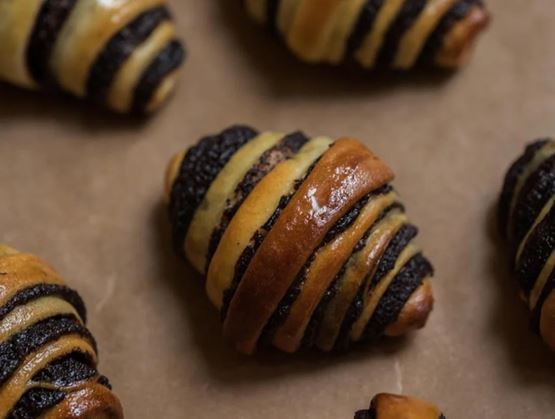
Heritage in motion: why pastries like rugelach matter at SIAL
As innovation continues to shape the future of global food, SIAL Paris remains a showcase for the dialogue between past and present, craft and technology. Heritage pastries such as rugelach gain renewed relevance within an international food industry exhibition where cultural storytelling is increasingly valued by buyers, chefs and producers. In an era when consumers seek authenticity alongside novelty, understanding the origins of a pastry becomes just as important as reimagining its flavours.
Rugelach therefore stands as a symbol of culinary migration and reinvention. It is a pastry shaped by history, yet continually adapted by the hands of new bakers, new cultures and new generations. Through SIAL OFF, it becomes part of a broader reflection on how festive traditions endure, evolve and inspire creativity within today’s rapidly changing gastronomic landscape.
Image credit: Babka Zana
Chocolate-Cinnamon Rugelach by Ambre Huerre-Paitry
Ingredients:
Rugelach dough
- 240g cold Philadelphia cream cheese or mascarpone
- 225g cold cubed butter
- 1 egg yolk
- 300g flour
- A pinch of salt
Filling
- 1 tablespoon unsweetened cocoa powder
- 1 tablespoon ground cinnamon
- 100g sugar
- 100g dark chocolate
- 50g melted butter
Syrup
- Water
- Sugar
Preparation:
Start with the dough!
- In a mixing bowl, combine the flour, egg yolk, salt, cold cubed butter, and cold Philadelphia cream cheese. Mix until you get a smooth dough. I recommend using a stand mixer with a dough hook.
- Divide the dough into two portions, wrap in plastic wrap, and refrigerate for 30 minutes.
- For the filling, chop the dark chocolate into fine chips, then add the cocoa powder, sugar, and cinnamon.
- Roll out both portions of dough with a rolling pin into circles about 30 cm in diameter and 3 mm thick.
- Spread the softened butter over the entire dough circle.
- Sprinkle the filling mixture evenly on top, then cut the dough into 12 triangles.
- Roll up the triangles from the smallest end to the widest.
- Refrigerate the rolled-up rugelach for 30 minutes.
- Preheat your oven to 180°C (350°F).
- Before baking, brush the rugelach with an egg-water mixture.
- Bake for 20 to 25 minutes.
- While baking, prepare the syrup by mixing equal parts water and sugar.
- Once the rugelach are out of the oven, brush them with the syrup.
Recommended shop: Babka Zana, where you can find delicious, indulgent rugelach with chocolate and cinnamon, as well as other flavors.