
LIONHEART’S SIAL FOR CHANGE SUCCESS STORY

SIAL For Change was launched at SIAL Paris 2024 as the show’s first award dedicated to Corporate Social Responsibility, created to spotlight agri-food companies building responsibility into their strategy, operations and supply chains. Its purpose is not simply to reward good intentions. It was designed to identify businesses capable of translating sustainability into practical models: better agricultural practices, fairer value distribution, stronger communities and lower-impact production.
For LIONHEART, a Philippine company based in Palawan, that platform became a powerful moment of recognition. In 2024, the company received the Jury’s Favourite Prize in the SIAL For Change category for its CSR strategy and sustainable agriculture model. The award placed its coconut flower sap value chain in front of international buyers, suppliers and partners looking for credible examples of regenerative agriculture in action.
A different reading of the coconut tree

LIONHEART works across the coconut flower sap value chain, from cultivation to product development and international distribution. Rather than building its model around coconut oil or whole coconuts alone, the company taps coconut flower sap and transforms it into natural sweeteners, condiments and beverages through brands such as COCOES and The Power of SLOW.
This shift in focus is important. Coconut is one of the emblematic crops of the Philippines, but many coconut-growing communities have long faced fragile incomes, ageing farmer populations and limited access to higher-value markets. LIONHEART’s model seeks to address that imbalance by treating the coconut palm not as a commodity tree, but as a platform for added value. Coconut flower sap can be turned into products with a broader range of uses, from pantry staples to functional beverages, while giving farmers access to a more stable and diversified value chain.
Today, the company describes itself as the Philippines’ largest regenerative coconut farm operation and the world’s only fully integrated coconut sap product producer. It operates 3,500 hectares in Palawan with more than 500,000 high-yielding palms. This scale gives LIONHEART a distinctive position: it is not only developing consumer products, but managing the agricultural, processing and distribution systems behind them.
Regenerative farming with a social purpose
LIONHEART’s proposition is built around the idea that coconut agriculture can be more productive, less extractive and more attractive for the next generation. The company presents coconut flower sap production as a higher-value and lower-impact use of the coconut tree, with a model described as more productive per hectare and less water-intensive than conventional approaches centred only on coconut oil or whole coconuts.
In South Palawan, the company is also involved in agroforestry and land restoration initiatives, including work in degraded scrubland and grassland areas. This gives the project a wider environmental dimension. Regenerative agriculture is not treated only as a label, but as a framework for rebuilding soil, supporting biodiversity and using land in ways that can generate both ecological and economic value.
The social dimension is equally central. LIONHEART works directly with Filipino coconut farmers, offering fair compensation, training and access to global markets. Its approach is rooted in the idea that rural communities need viable futures, not just seasonal income. By creating agricultural employment, building skills and connecting farmers to international demand, the company seeks to make farming a more stable and respected profession.
This is especially relevant in a sector where succession is becoming a concern. If younger generations see agriculture only as low-margin labour, rural economies weaken. LIONHEART’s response is to connect farming with product innovation, export markets and purpose-led business. Its CSR approach is therefore not separate from its commercial model. It is part of the way the business is designed to grow.
What SIAL For Change brought to LIONHEART?
For LIONHEART, SIAL For Change 2024 brought more than visibility. It gave the company an international validation point at a moment when it is preparing for its next phase of growth. The company says it has recently pre-launched its flagship functional beverage, The Power of SLOW, with plans for US market entry in 2026 and expansion in Europe.
LIONHEART explains: “SIAL For Change 2024 brought us invaluable global recognition through our Favourite Recognition award, which validates our initiatives in the sustainable transformation of agriculture and connects our farm to the world through international partners who share our vision of transforming traditional farming into regenerative systems that benefit both people and the planet.”
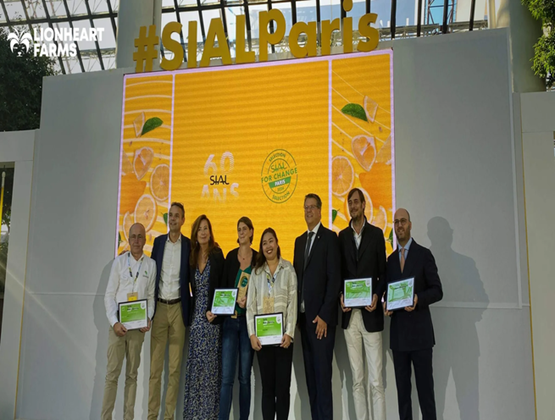
That recognition carries commercial weight. Abigail Chang, Product Manager at LIONHEART, says: “When I engage with European clients and suppliers, I bring up our SIAL For Change recognition. SIAL Paris carries weight in Europe, so the recognition opens doors. It signals that we’re serious, a partner they trust to deliver.”
For a company seeking to bring Philippine coconut flower sap products into more international channels, that trust is valuable. Buyers increasingly want more than a product sample and a price list. They want evidence of traceability, credible sourcing, social impact and environmental discipline. SIAL For Change gave LIONHEART a format in which those layers could be made visible.
From Palawan to a wider food movement
LIONHEART’s story reflects a broader shift within the food sector. Innovation is no longer measured only by flavour, packaging or convenience. It is increasingly measured by the systems behind a product: how land is used, how farmers are paid, how communities benefit and how supply chains can become more resilient.
This is where SIAL For Change has a particular role to play. The initiative will return at SIAL Paris 2026, from 17 to 21 October at Paris Nord Villepinte, with the competition continuing to highlight start-ups, SMEs and large companies committed to sustainable, ethical, environmentally responsible and fair initiatives. Participants will be assessed on criteria including originality, impact, scalability and alignment with sustainability objectives and CSR principles, with the awards ceremony scheduled for 18 October 2026 on the SIAL Talks stage.
For LIONHEART, the recognition received in 2024 is part of a longer journey. Its model connects a local agricultural resource with international product development, but it also asks a larger question: what happens when a crop is valued not only for yield, but for the communities, ecosystems and futures it can support?
At SIAL Paris, where thousands of exhibitors and hundreds of thousands of products are expected in 2026, such stories help redefine what a food innovation exhibition can bring to the market. LIONHEART’s work in Palawan shows that responsible growth can begin quietly, with a tree, a farmer and a slower way of thinking. From there, it can travel far.
Image credits:
LIONHEART
rhoda alex - Unsplash