
DIGITAL MEDIA’S INFLUENCE ON FOOD TRENDS

SIAL Paris does more than organise a global gathering for professionals. Through whitepapers, studies and surveys such as this collaboration with OpinionWay, it provides insight into evolving consumer behaviours, helping exhibitors and visitors understand emerging dynamics and anticipate shifts shaping the market.
Methodology
The OpinionWay Survey for SIAL on French people, food and social media, is based on a sample of 1,033 individuals representative of the French population aged 18 and over, surveyed online between 11 and 12 March 2026. Quotas were applied to ensure alignment with national demographics across gender, age, socio-professional category and geography.
This framework offers a statistically robust overview, with a margin of error between 1.4 and 3.1 percentage points.
The food accounts followed on social media
Social media has become a gateway to food content, though engagement remains selective. Overall, 37 percent of French respondents follow at least one type of food-related account.
Among these, 18 percent follow food brands, while 17 percent follow chefs or culinary professionals. Influencers focused on recipes attract 16 percent of respondents, matching the share who follow nutrition experts, lifestyle creators or restaurant recommendation accounts.
Engagement is strongly shaped by age. Among 18 to 24 year olds, 81 percent follow at least one type of food account, compared with just 13 percent among those aged 65 and over.
These figures point to a generational divide in how food content is consumed and suggest that digital influence is particularly concentrated among younger audiences.
The influence of social media on everyday eating
Beyond simple exposure, social media plays a role in shaping daily food practices. More than half of respondents, 52 percent, report being influenced in at least one aspect of their eating habits.
The most affected area is cooking behaviour. Forty-four percent say that platforms influence the recipes they prepare at home.
Health-related motivations also emerge, with 41 percent stating that social media affects their desire to eat more healthily.
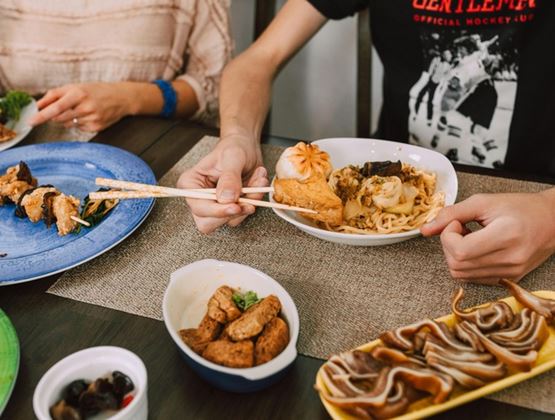
At the same time, indulgence remains present. Thirty-six percent acknowledge that their “pleasure” food cravings are shaped by digital content, while 35 percent say it influences the places they choose to eat.
This dynamic can be illustrated by the popularity of formats such as mukbang videos, where creators film themselves consuming large quantities of food while interacting with audiences. Originally emerging in South Korea, these videos have become widely viewed across platforms, combining spectacle, comfort and sensory appeal. Their success points to how visual excess and performative eating can stimulate appetite and normalise indulgent consumption patterns.
Other areas include product purchases, cited by 33 percent, and even the presentation of dishes, mentioned by 32 percent.
Here again, generational differences are significant. Among 18 to 24 year olds, 90 percent report some form of influence, compared with 26 percent among those aged 65 and above.
The social platforms that influence food choices
Nearly half of respondents, 48 percent, identify at least one social network as having an influence on their eating habits.
Facebook leads with 13 percent, followed by Instagram at 12 percent and YouTube at 11 percent. TikTok accounts for 8 percent, while Pinterest and Snapchat each register 2 percent.
However, 52 percent say that no platform influences their food behaviour, indicating that while digital channels are important, they do not yet dominate across the entire population.
Age again plays a decisive role. Among younger respondents, TikTok reaches 41 percent influence among 18 to 24 year olds, while Instagram and YouTube are particularly strong among those aged 25 to 34.
The influence of content on actions
The study also examined how exposure translates into concrete behaviour. Over the past 12 months, 38 percent of respondents have prepared a recipe discovered on social media.
Experimentation is also evident, with 28 percent having tried new ingredients they had not previously consumed.
A quarter, 25 percent, have tested innovative food products, while 24 percent have tried a viral dish or snack.
Purchasing behaviour is affected as well, with 23 percent having bought a product that became popular online.
This progression from viewing to action is closely linked to the growing role of commercial partnerships on social platforms. Brand collaborations, sponsored content and product placements have become a significant revenue stream for creators, shaping the visibility of certain products and trends. For food brands, this model offers rapid exposure and the ability to position products within everyday usage scenarios, often accelerating their adoption among audiences.
Social sharing is part of the cycle, as 20 percent have posted photos of dishes they prepared, and 13 percent have even consulted a nutrition professional after seeing related content. These actions suggest that digital exposure can extend beyond inspiration to tangible consumption and decision-making, with commercial dynamics increasingly intertwined with everyday food choices.
The impact on dietary habits
Social media influence is not limited to isolated behaviours but can also shape broader dietary patterns. Overall, 41 percent of respondents report at least one change in their eating habits linked to social media.
Health-oriented adjustments are prominent. Twenty-five percent say they have reduced sugar intake, while 24 percent report paying more attention to salt consumption.
Protein intake has increased for 24 percent of respondents, and 21 percent say they have reduced fat consumption.
Interest in functional ingredients is also visible, with 20 percent consuming more “superfoods” such as chia seeds or spirulina.
At the same time, shifts towards plant-based consumption are noted, with 19 percent reducing animal products and 18 percent trying plant-based alternatives.
Other changes include reduced alcohol consumption, cited by 17 percent, and limiting carbohydrates, also at 17 percent.
These developments point to a dual dynamic where social media can encourage both healthier behaviours and more indulgent choices, depending on the content consumed.
The real question
A final question emerges from these findings. Are food trends being created by social media, or simply accelerated by it? The data suggests a more nuanced dynamic. Platforms do not operate in isolation but act as amplifiers, increasing the speed and scale at which ideas circulate, from recipes and products to broader dietary shifts.
With 52 percent of respondents reporting some degree of influence and 41 percent identifying changes in their eating habits, digital content appears less as a driver of entirely new behaviours than as a catalyst that intensifies existing ones.
For professionals across the food sector, these insights provide a clearer understanding of how trends emerge and circulate. At Sial Paris, where innovation, consumer expectations and market strategies intersect, such data offers a valuable lens through which to interpret the evolving relationship between food and digital culture.
Image credits:
Robin Worrall - Unsplash
RDNE Stock project - Pexels