
CERTIFICATION, CREDIBILITY AND THE FUTURE OF FOOD TRANSPARENCY

The modern food label has evolved far beyond basic nutritional information. It now operates as a compact narrative, carrying claims about origin, environmental impact, ethical sourcing and production methods. This transformation reflects a broader shift in consumer expectations, where purchasing decisions are increasingly informed by values as much as by price or taste.
Across Europe, this shift is measurable. According to the European Commission, more than half of EU consumers consider environmental or ethical aspects when buying food. Globally, around 78 per cent of consumers say a sustainable lifestyle is important to them. These figures underscore why labels and certifications have moved from optional marketing tools to strategic necessities across food industry sectors.
Public certifications as a regulatory anchor
Public certification systems continue to provide the backbone of trust in the food chain. Schemes such as the EU organic label, Protected Designation of Origin and Protected Geographical Indication are grounded in regulation and offer a harmonised framework for quality and traceability.
The economic significance of these labels is considerable. According to the most recent data from The Research Institute of Organic Agriculture FiBL, organic food and drink sales in Europe surpassed €136 billion in 2023, demonstrating sustained demand for certified products. France remains one of the leading markets, reflecting both strong domestic production and high consumer engagement.
However public certification is no longer static. Regulatory frameworks are evolving to incorporate environmental and social dimensions, from biodiversity protection to carbon impact. This expansion reflects growing political and consumer pressure for food systems to demonstrate measurable sustainability outcomes.
For producers, however, compliance can be complex. Certification processes often involve detailed documentation, audits and ongoing monitoring. While these measures reinforce credibility, they can also create barriers, particularly for smaller operators navigating multiple standards across different markets.
Private labels and retailer-driven standards
Alongside public schemes, private certifications have gained prominence. Retailers and major brands increasingly define their own standards, often focusing on areas such as animal welfare, sourcing transparency or environmental performance.
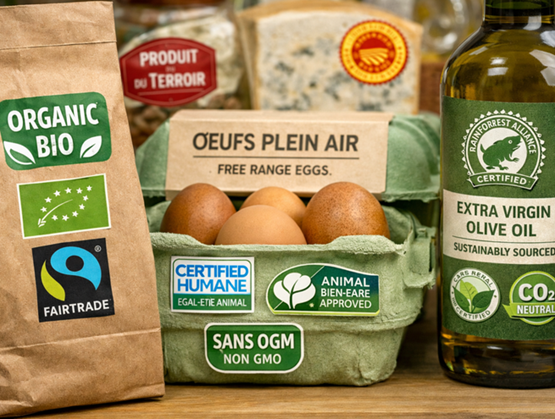
For a grocery products exhibitor, meeting these requirements can be essential for market access. Retailers use private labels not only to differentiate their assortments but also to exert greater control over supply chains. In sectors such as dairy, seafood and fresh produce, these standards have become deeply embedded in procurement practices.
This growth in private certification has contributed to a more fragmented landscape. While some schemes are highly rigorous, the proliferation of logos can create confusion for consumers. The challenge lies in balancing differentiation with clarity, ensuring that labels remain meaningful rather than overwhelming.
At the same time, private standards often move faster than public regulation. They can respond quickly to emerging concerns, whether related to climate impact or packaging reduction, positioning them as drivers of innovation within the food industry.
Certification as a driver of innovation and trade
Certifications are increasingly influencing not only how food is marketed but also how it is developed and distributed. In global supply chains, third-party standards such as Fairtrade or Rainforest Alliance provide common benchmarks that facilitate trade and build trust between partners.
The economic impact can be significant. According to the International Trade Centre, certified products can command price premiums in certain categories, reflecting perceived added value. This dynamic reinforces the role of certification as both a commercial and reputational asset.
Certification also intersects with innovation. Emerging product categories, including plant-based foods and functional ingredients, often rely on labels to establish credibility. Whether signalling organic sourcing, non-GMO status or reduced environmental impact, certifications help translate technical attributes into consumer-facing value.
Evolving distribution models further highlight this role. As digital-first concepts and new formats reshape how food reaches consumers, certification acts as a stabilising factor, ensuring that trust accompanies experimentation and scale.
Navigating complexity: cost, credibility and communication
Despite their benefits, labels and certifications present ongoing challenges. One of the most pressing concerns is credibility. Maintaining robust verification systems across global supply chains requires significant resources, and any inconsistency can undermine trust.
Cost remains another barrier. Certification involves audits, administrative processes and compliance measures that can be demanding, particularly for smaller producers. This raises questions about inclusivity and access, especially in developing regions where certification can open doors to international markets.

Consumer understanding is equally critical. While awareness of well-established labels such as organic or fair trade is relatively high, newer or more specialised certifications may be less familiar. This creates a communication challenge for brands seeking to convey complex information in a simple and accessible way.
Digital tools are beginning to address this gap. Technologies such as QR codes and traceability platforms allow consumers to access detailed product information beyond the label itself. Although still emerging, these tools suggest a future where transparency is not limited to packaging but extends into interactive, data-driven experiences.
Towards clearer and more unified standards
The trajectory of food certification points towards greater harmonisation. Industry stakeholders and policymakers are exploring ways to align standards, reduce duplication and improve transparency across markets.
Environmental labelling is a particular focus. Efforts to standardise how carbon footprints and sustainability metrics are measured could bring greater consistency to claims that are currently fragmented. If successful, such initiatives may help restore clarity in a crowded labelling environment.
For businesses operating across the food sector, adapting to this evolving landscape will require both flexibility and strategic alignment. Certifications are no longer peripheral considerations but central elements of product positioning and market access.
At SIAL Paris, these developments come into sharp focus. The event provides a platform where public authorities, private organisations and industry players converge to examine how labels and certifications are shaping the future of food. In a marketplace defined by scrutiny and expectation, trust has become a currency, and certification remains one of its most visible expressions.
Image credit: MealPro - Unsplash