
BAGHRIR, THE THOUSAND-HOLE PANCAKE THAT CELEBRATES NORTH AFRICAN HOSPITALITY

SIAL Off extends the SIAL Paris experience beyond the exhibition halls and into the city, guiding visitors through inspiring and gourmet addresses across Paris, from refined restaurants and lively bars to shopping spots and places of inspiration. Alongside these Parisian recommendations, members of the SIAL Paris team share recipes that open a more personal window onto international food cultures. This time, Hocine presents Baghrir, the North African pancake often known as the “thousand-hole” pancake.
At first glance, Baghrir looks almost delicate, a pale round of semolina batter covered in tiny craters. Yet those holes are the secret to its character. They turn the pancake into a sponge, ready to absorb honey, melted butter, jam or any sweet topping placed upon it.
A pancake shaped by memory and technique
Baghrir, also known as ghrayef or mchahda, belongs to the culinary landscape of the Maghreb, where grains, fermentation and hospitality have long shaped everyday cooking. Although its origin is unknown, the recipe has been passed down through generations to become an important part of North African tradition. Made from fine semolina, flour, yeast and warm water, it is less a showpiece than a gesture. Baghrir is eaten across Morocco, Tunisia and Algeria, where it is tied to home cooking, family gatherings and everyday hospitality, and is commonly served warm with mint tea or at iftar during Ramadan.
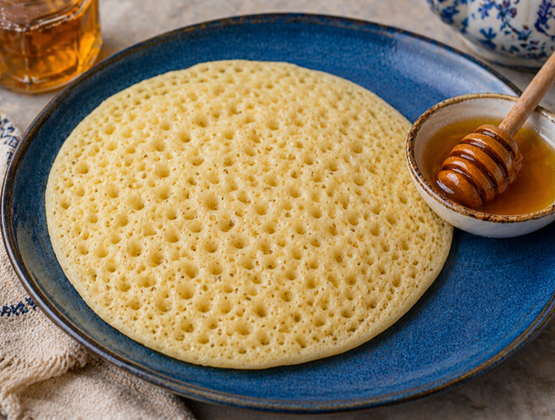
The batter carries the story. Semolina gives Baghrir its soft structure and faint grainy depth, while yeast and baking powder create the bloom of holes that gives the pancake its famous surface. Unlike French crêpes, Baghrir is not flipped. It cooks only on one side. As steam rises through the batter, bubbles open across the top and remain there, forming the texture that allows syrup, honey or butter to disappear into the pancake rather than simply sit on top.
The ritual of the “thousand holes”
In North African homes, Baghrir is often less about strict plating and more about rhythm. The pan is heated, the batter is poured, the holes appear, and the finished pancake is set aside before the next one begins. The process is repetitive, almost meditative. Each pancake is judged by its surface. Too few holes can mean the batter is too thick, the yeast too tired or the pan too hot. The perfect Baghrir is pale, soft and dotted with a fine honeycomb.
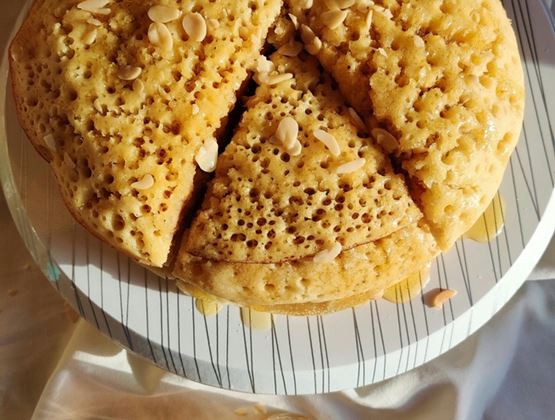
That balance between simplicity and precision explains why Baghrir has endured. It relies on everyday ingredients but rewards attention. It is economical, generous and highly adaptable. The classic topping is honey and melted butter, sometimes scented or enriched according to household preference. Others use jam, olive oil, date syrup, fruit or amlou, a Moroccan spread blending argan oil, almonds and honey. The pancake itself remains neutral enough to receive sweetness without becoming heavy.
For the modern food industry show audience, Baghrir also illustrates a wider point: some of the most compelling food innovations are not always new inventions. They can be rediscoveries of traditional formats that already answer contemporary expectations. Baghrir is plant-forward at its base, made largely from cereals and water. It is visually distinctive, shareable, low-waste and easily adaptable to different toppings. Its texture alone feels made for social media, yet its roots are much older than any trend cycle.
From the Maghreb to Paris
Paris has long been shaped by North African food cultures, from couscous restaurants and Algerian bakeries to Moroccan tea rooms and Tunisian street-food counters. Baghrir sits comfortably within that wider culinary exchange. It is intimate rather than spectacular, but it carries a strong sense of place. It speaks of kitchens where recipes are transmitted by sight and feel, where batter is adjusted with a splash of water, and where the first pancake often acts as a test.
Hocine recommends Majouja, an Algerian restaurant in Paris’s 9th arrondissement, as a place to eat Baghrir and discover other Algerian specialities. That detail fits naturally within the spirit of SIAL Off: food as a route through the city, and the city as a living extension of the table.
At SIAL Paris, where global food cultures meet the business realities of sourcing, distribution, innovation and hospitality, Baghrir offers a quieter but meaningful lesson. Tradition can travel without losing its soul. A pancake made from semolina, flour and water can carry history, technique and affection across borders. In a food exhibition context often focused on what comes next, Baghrir reminds the industry that heritage remains one of the richest sources of inspiration.
Get inspired and follow Hocine’s recipe for perfect Baghrir.
Hocine’s Baghrir recipe
This recipe makes around 15 small Baghrir pancakes of approximately 12 cm, although the final number depends on the size of the pan used.
Ingredients
300 g very fine or fine semolina, not couscous semolina
125 g flour
630 ml lukewarm water
A pinch of salt
1 level teaspoon fresh or dried baker’s yeast
1 teaspoon caster sugar
2 sachets of baking powder, 7 g each, or 1 sachet of 11 g
Honey, melted butter, jam or another sweet topping, to serve
Method
- Dilute the baker’s yeast with a little of the lukewarm water, taken from the total 630 ml.
- Pour the remaining water into a blender and add the diluted yeast. When using dried yeast, add it after the flour.
- Add the semolina, salt, sugar and flour, then blend thoroughly until the mixture is smooth and full of bubbles.
- Add the baking powder and mix well one final time.
- Pass the batter through a fine sieve to remove any lumps.
- Leave the batter to rest for 10 to 20 minutes, but not longer. It can also be cooked immediately once the batter is ready.
- Heat a pan and pour in a small ladleful of batter. The batter should just cover the surface of the pan. Avoid adding too much, otherwise the Baghrir will be too thick.
- Cook on one side only, without flipping, until the surface is dry and covered with small holes.
- Serve warm with honey, melted butter, jam or the sweet topping of choice.
Image credits:
Nour al Huda Zardan - Pexels