
ADULTS DEVELOP A SWEET TOOTH FOR CANDY

Candy isn’t merely a treat for children that is slipped into a pocket or shared at birthday parties. In recent years, it has become a fully fledged cultural product, consumed as much with the eyes and ears as with the palate. Across social media platforms, brightly coloured gummies, crunchy freeze-dried sweets and oversized novelty formats generate millions of views, often driven by adults searching for fun, nostalgia and sensory stimulation. This renewed enthusiasm reflects a deeper shift in how confectionery is positioned within the wider food economy, a shift that is increasingly visible at global industry gatherings such as SIAL Paris.
The latest SIAL Unpack video places the candy industry firmly within this evolving landscape. Rather than treating confectionery as a side category, the video frames it as a barometer of broader consumer trends, from experiential eating to premiumisation and global flavour curiosity. This perspective resonates with what is happening on the ground: candy has become playful, expressive and, crucially, multi-generational.
Candy, culture and the adult consumer
One of the defining features of today’s candy boom is its appeal to adults. In many mature markets, growth is no longer driven solely by children but by consumers in their twenties, thirties and beyond, who associate sweets with comfort, escapism and even self-expression. According to industry analysts, the global candy market was valued at around $75 billion (€≈64.5 billion) in 2025 and could approach $100 billion (€≈86 billion) by the end of the decade, fuelled largely by adult demand and premium formats. Asia Pacific alone is expected to represent over $54 billion (€≈46.5 billion) by 2030, reflecting both population scale and rising disposable incomes.
Social media has amplified this shift. ASMR tastings, “mukbang” candy sessions, in which creators film themselves consuming large quantities of food while engaging directly with viewers, and visually striking unboxings turn confectionery into entertainment, extending its value beyond taste alone. Texture and sound have become as important as flavour, with sour coatings, popping centres and freeze-dried crunch offering new sensory dimensions.

Some products now explicitly play on this multi-sensory appeal, such as lollipops incorporating bone conduction technology to transmit sound through the teeth. For brands, this means designing products that perform well on screen as well as on shelves, a reality increasingly discussed within food industry sectors focused on innovation and marketing.
Boutique chains and the reinvention of candy retail
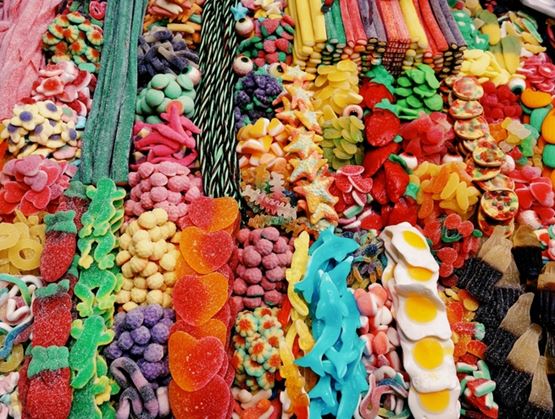
This renewed interest has reshaped retail as well as products. In the United States, boutique chains such as BonBon, Candycopia and Lil Sweet Treat have gained attention by offering curated, design-led pick-and-mix experiences. Their stores are compact, visually striking and carefully merchandised, often featuring imported gummies from Scandinavia, Japan or Germany alongside familiar American classics. Importantly, these concepts keep prices accessible, reinforcing the idea that indulgence can be premium without being exclusive.
Similar dynamics can be observed in Europe and Asia. In the UK, boutique confectionery and chocolate shops increasingly focus on provenance, single-origin ingredients and limited editions, blurring the line between candy and fine food. In Japan, long known for its inventive snack culture, confectionery brands continue to push boundaries with seasonal flavours, region-specific recipes and meticulous packaging designed for gifting. Meanwhile, established global players such as Godiva have expanded experiential retail concepts in Asian cities, combining confectionery boutiques with cafés to create immersive brand environments.
These retail models highlight how candy has matured into a category that thrives on storytelling and experience. Consumers are not just buying sweets; they are buying moments, memories and shareable experiences.
Innovation, health and sustainability pressures
Behind the colourful displays, the confectionery industry faces the same structural challenges as the wider food sector. Rising raw material costs, particularly for cocoa, sugar and dairy inputs, continue to put pressure on margins. Climate volatility and geopolitical disruptions have made sourcing more complex, encouraging manufacturers to rethink supply chains and pricing strategies. At the same time, health considerations are reshaping product development. Reduced-sugar recipes, alternative sweeteners and functional candies enriched with vitamins or probiotics are gaining ground, especially among health-conscious adults who still want to indulge without guilt.
Sustainability is another key driver. Packaging waste, ethical sourcing and environmental impact are increasingly scrutinised by consumers and regulators alike. In response, confectionery brands are experimenting with recyclable or compostable wrappers, responsibly sourced cocoa and transparent labelling. These efforts mirror broader conversations taking place at SIAL, where innovation is framed around responsibility as much as creativity.
Candy’s place at SIAL
As a leading global food trade show, SIAL Paris offers a unique vantage point from which to observe these transformations. Confectionery sits alongside categories ranging from dairy and bakery to beverages and plant-based foods, reinforcing its role as an integral part of the international food ecosystem. Exhibitors use the event to test new concepts, gauge international interest and connect with buyers looking for products that combine originality with commercial potential.
By highlighting candy within a broader narrative of food innovation, SIAL underscores how even the most playful categories reflect serious shifts in consumer behaviour, technology and market structure. Candy becomes a lens through which to understand indulgence, wellness, sustainability and globalisation.
A category that mirrors the times
Ultimately, the resurgence of candy speaks to something deeper than sugar and colour. It reflects a consumer desire for joy in uncertain times, for products that offer sensory escape while still aligning with modern values. Whether through a Scandinavian gummy picked up in New York, a limited-edition Japanese sweet or an innovative reduced-sugar formulation showcased in Paris, confectionery continues to evolve in step with the world around it.
As SIAL Paris and its global community look towards the future edition from 17 to 21 October, candy’s role within the food sector seems set to grow rather than fade. No longer confined to childhood, it stands as a creative, commercially significant category that captures the spirit of contemporary food culture, playful on the surface, but deeply connected to the forces shaping the global marketplace.
Image credits:
Luis Aguila – Unsplash